Spermicide Uses Nanoparticles and Chemotaxis for Discreet, OTC Product
GREENSBORO, N.C., April 13, 2022 /PRNewswire/ — AT Research Partners has been granted US patent #11,298,375, Brady, et.al. for a contraceptive breakthrough targeting spermatozoa, the “weakest link” in reproduction. The patent was pro se filed and granted in 6 months at a fraught family planning moment, when Texas and other states have been further restricting and seeking to criminalize women’s reproductive choices.

Lead inventor, Terry Earl Brady, asserted, “Unimpeded family planning requires a biologically neutral OTC contraceptive to erase the political narrative from the public sphere and restore reproductive rights to the individual’s control and privacy. This invention addresses that need, offering a global opportunity in the FemTech space.”
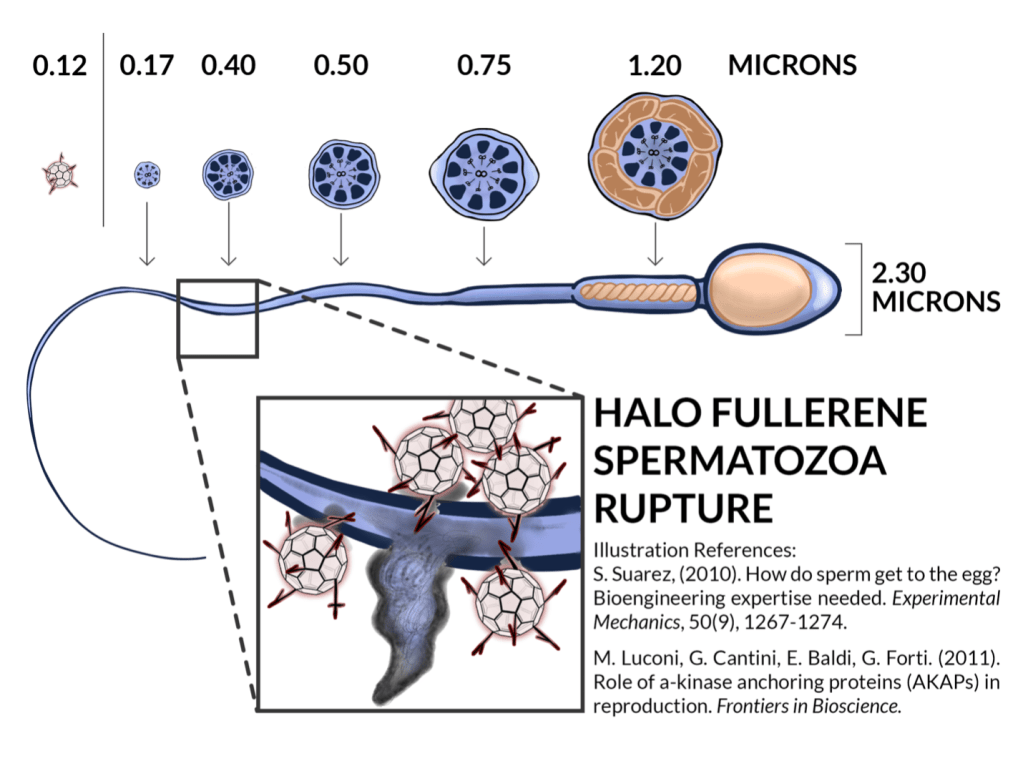
With barely 40% typically capable of fertilization, human sperm are the smallest cells in mammalian biology. As such, the distal segment of sperm tails approaches the same scale as nanoparticles; whereby, this invention employs chemotaxis and halogenated fullerenes, a form of nanoparticle, to harbor, sever and render them immotile.
The patent leverages other spermatozoa properties that include the chemotactic drivers that normally draw them to fertile ova – and their competitive response to ambient signals. The innovation includes the same molecules as those emitted by a fertile egg, so the sperm are “attracted” to the spermicide in the vaginal cul-de-sac instead of the uterine path to fertilization. In addition, a second chemotactic diversion in the formulation is based on molecules that mimic the presence of competitive sperm. The combined effect is to concentrate the spermatozoa and generate extreme agitation from a competitive stimulant – to harbor and sever them in the process while exposed to the halo fullerenes. Destruction of the distal segments immobilizes and thus destroys the sperm with millions of nano “collisions” from a few drops of the spermicide.
Based on UN projections, the annual incidence of heterosexual intercourse may be as high as 435 billion, worldwide. “With years of patent protection, even a fraction of this potential market represents an unparalleled opportunity for a universally acceptable, affordable method for a biologically neutral, safe, easy and effective contraceptive under a woman’s control,” said Anthony Dellinger, co-inventor and co-founder of AT Research Partners.
AT Research Partners is seeking a pharma or FemTech partner to help develop and manufacture the invention. Notably, the active ingredients for an individual lifetime supply of this innovation would fit in a teaspoon, and a year’s manufacturing inventory for global distribution could be secured at a single facility.
###
About AT Research Partners:
AT Research Partners is affiliated with the Joint School of Nanoscience and Nanoengineering (JSNN, UNC and A&T University, Greensboro, NC) and associated with Kepley BioSystems infectious disease and other impactful initiatives. AT advises a new view of academic curricula regarding intellectual property (IP) when taught at JSNN and STEM education more broadly (industry policy).
About this Patent:
US patent #11,298,375 is entitled, Halogenated fullerene functionalized as a biocidal and chemotactic spermicide to vaginally harbor and neutralize spermatozoa for use as a safe and effective contraceptive, Brady, et.al., also including, A. L. Dellinger, M.K.M. Goddard and K.B. Dellinger. Pro se filed and granted April 12, 2022.
Other inventions include a nanotechnology patent: #10,934,168, entitled: Synthetic, multifaceted halogenated, functionalized fullerenes for microbiocidal effects employing controlled contact for safe therapeutic and environmental utility; pro se filed and issued March 2, 2021, Brady, et.al.
Contact:
Anthony L. Dellinger, PhD – Principal
AT Research Partners
Phone: +1-703-675-0277
Email: 334021@email4pr.com
Web: atresearchpartners.com
SOURCE AT Research Partners
 AT Research Partners
Leave a comment